Congratulations to the winners of the 2026 Press Freedom Awards!
Press Freedom Award Winner Frédérik Plante

Frédérik Plante has waged a running battle with the Quebec government over its attempts to clamp down on freedom-of-information requests and withhold evidence of police racial profiling.
Three years ago, as a reporter for The Globe and Mail in Montreal, Plante began asking Quebec police through FOI requests for race-based data on police stops. Almost all police departments denied the requests. Some claimed the data did not exist.
Plante appealed those decisions and, over the past three years, worked to secure data in some of Quebec’s largest cities. The fight for transparency revealed the overpolicing of Black and Arab communities in Longueuil, Quebec City, and Laval, suggesting widespread racial profiling.
Plante also sought provincewide data on arbitrary stops from Quebec’s Ministry of Public Security, which police forces are now legally required to provide. When the ministry failed to release the information, he again turned to the Access to Information Commission.
Rather than address whether the data existed and could be made public, the ministry’s lawyers moved to disqualify the appeal, arguing Plante was acting for his then-employer, the Globe. Since only lawyers can represent businesses, they claimed, the appeal was invalid.
Plante argued he was acting on his own behalf, and that it made no difference whether the data was published in the Globe, or any other publication. In line with earlier commission decisions, he won the case in 2025.
Last April, the provincial court denied the government’s application for an appeal.
Quebec is now seeking a judicial review from the Superior Court of Québec, which could overturn the previous decisions.
The move is unprecedented and arguably the most serious threat to press freedom from the Quebec government in two decades. If the ministry wins, journalists appealing freedom-of-Information decisions may have to retain lawyers simply to enforce provisions that public institutions routinely violate.
Plante moved to Toronto last year to join The Star. He continues to pursue the legal cases on his own, with backing from the Fédération professionnelle des journalistes du Québec and a coalition of Quebec media. Because he no longer covers Quebec, he may never publish articles based on the data in question.
“At this point, I am not fighting to get a story,” he told us. “I am fighting to safeguard my Quebec colleagues’ — and the public’s — right to information.”
Press Freedom Certificate of Merit

Carrie Tait, Tom Cardoso, Mark Mackinnon, Stephanie Chambers, Tu Thanh Ha, Greg Mercer, Alanna Smith
When Globe and Mail Calgary based reporter Carrie Tait began breaking stories on conflicts of interest in Alberta Health Services, she became the target of a threatening intimidation campaign by anonymous figures.
The story began shortly after Athana Mentzelopoulos, the CEO of Alberta’s health authority, was fired in January 2025. She alleged her dismissal was due to her investigation of ties between procurement officials, the government and companies with which they had signed contracts.
Mentzelopoulos repeatedly referenced Sam Mraiche, owner of a medical supply business that had been awarded more than $600 million by the Alberta government.
Tait and her Globe colleagues uncovered stories about Mraiche, his government contacts and his business operations. The group included investigative reporter Tom Cardoso, foreign correspondent Mark MacKinnon, researcher Stephanie Chambers and Calgary reporter Alanna Smith.
While the team uncovered and reported on this growing controversy, it faced constant attacks on social media and on a podcast that questioned their integrity. Social media made clear Tait was being followed in Calgary. It was later revealed that Mraiche’s lawyer had employed the podcast team.
Globe reporters Tu Thanh Ha and Greg Mercer joined the story to investigate who was behind the intimidation campaign.
While the investigation into Mraiche, his ties to the Alberta government and health care procurement continues, the impact is widespread. One cabinet minister has resigned, and investigations by a retired judge, the auditor general and the RCMP have been established, with the latter two continuing.
Press Freedom Award, Local Journalism – The Green Line
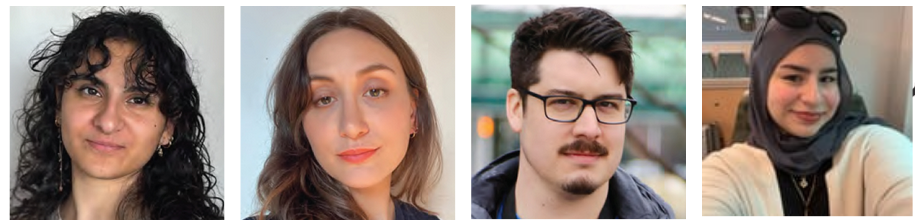
Yara El Murr, Mary Newman, James Westman, Aia Jaber
The Green Line launched in 2022 with a noble mission: “To make important information less boring and more user- friendly.”
From the get-go, the hyperlocal Toronto newsroom has focused on community-driven solutions journalism. The work, as they defined it: “Collaborate with people in the communities we serve to report on local solutions that target the sources — not the symptoms — of the biggest problems facing our city.”
Through a mix of investigative reporting, data journalism and video, James Westman, Mary Newman and Yara El Murr revealed how a major transit project was driving up rents, evictions and displacement in nearby communities.
The Green Line’s work extended to a community event that gathered activists, tenants, unions, land trusts, legal clinics and anyone who wanted to brainstorm solutions.
Not only did the series expose a critical local crisis, but it also gave residents hands-on tools, showcased solutions and strengthened public understanding of who benefits from city-building — and who gets pushed out.
“We believe this work exemplifies how journalism can empower communities, surface solutions and inspire action on pressing local issues,” Green Line publisher and editor Anita Li told us.
Career Achievement Award in honour of Spencer Moore Winner, Mark MacKinnon
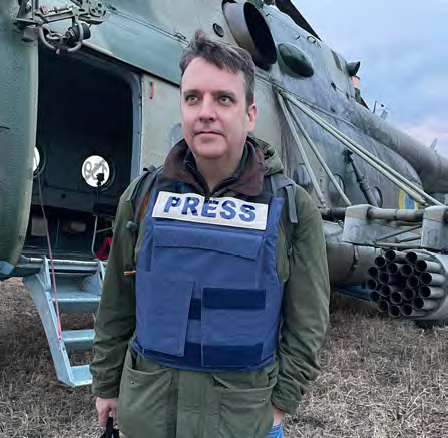
Covering a war is hard. Covering a war in its fourth year – and making sure Canadians are still reading, and caring, about what happens – is another challenge entirely.
Globe and Mail correspondent Mark MacKinnon has continued to deliver world-leading reportage from the front lines of the conflict, despite threats to his personal safety and the logistical difficulties posed by the oft-besieged electrical grid.
In 2025, he took readers to remote Velyka Pysarivka – just a few kilometres from Russian artillery positions – to deliver the heartwarming tale of how a local newspaper was acting as an information lifeline for the remaining residents of the battered village. MacKinnon went on the newspaper route with the husband-and-wife team behind Vorskla, sharing the risks they took as they delivered the latest edition of the newspaper even as the village was under fire that morning.
MacKinnon’s article inspired Globe readers to raise money that was used to buy new winter tires for the Vorskla delivery car.
MacKinnon also risked his safety to report on the sectarian violence inside Syria in 2025.
Seventeen years ago, he was banned from Syria over his fearless reporting on how Bashar al-Assad’s regime treated dissidents. While MacKinnon continued to report on Syria throughout the country’s long civil war, the collapse of the al-Assad dynasty finally allowed MacKinnon to return to Damascus, and meet again with some of his old friends and sources.
The new tension – between a country that rose up hoping for democracy, and the Islamist rulers who have taken al-Assad’s place – is captured in the main piece MacKinnon produced from a two-week reporting trip in February and March of 2025. In his article, Inside the New Syria, MacKinnon cuts back and forth between scenes of optimism, such as a street demonstration in Damascus that wouldn’t have been tolerate by the old regime, and others, such as an eruption of violence targeting the country’s Alawite minority, that reflect the enormity of the challenges ahead.
Student Achievement Award Winner Jenna Olsen
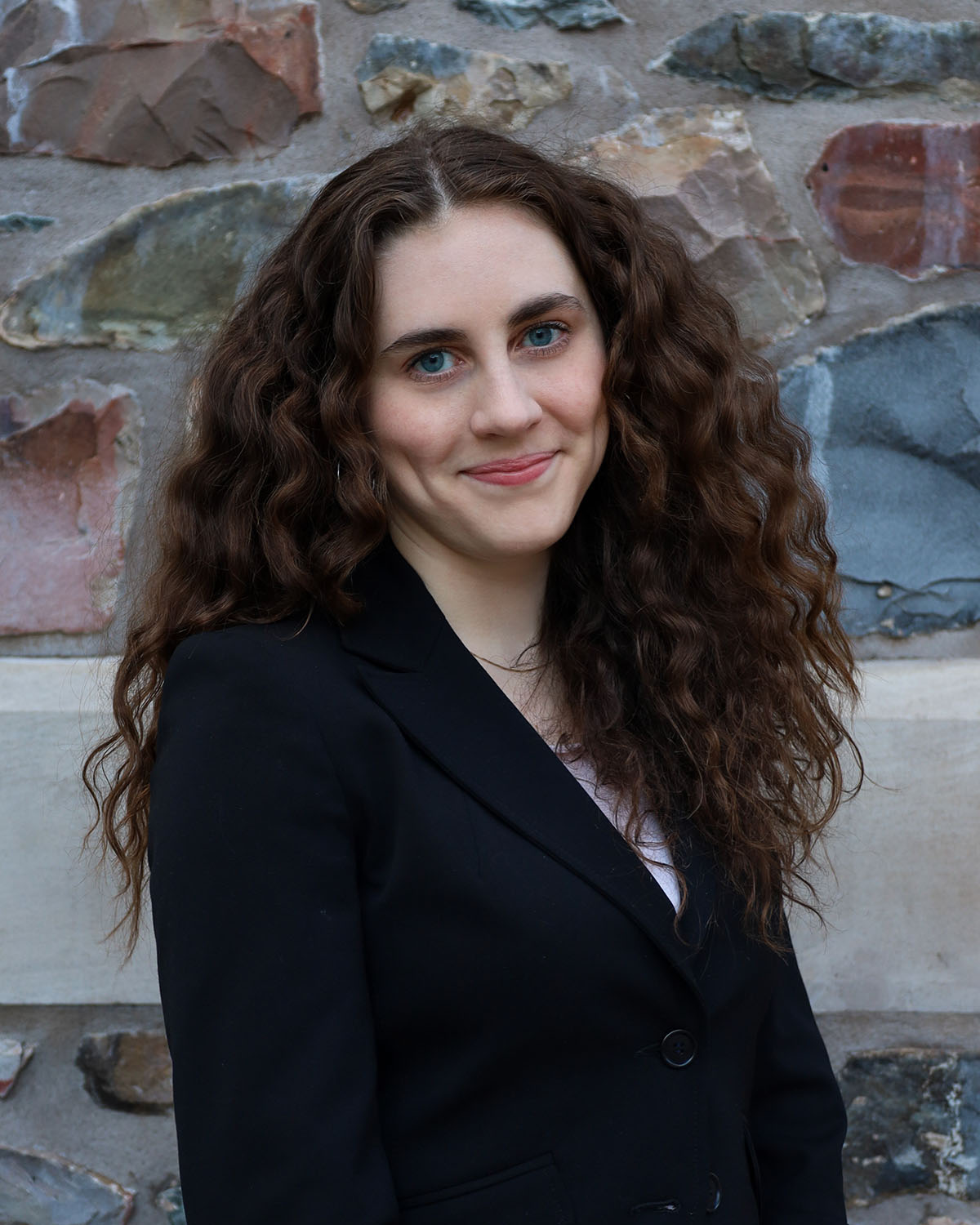
Jenna Olsen is already doing the kind of journalism most reporters dream about for year.
Before heading into her final year of journalism school at the University of King’s College in Halifax, Olsen spent last summer as an intern with the Investigative Journalism Bureau at the University of Toronto’s Dalla Lana School of Public Health.
She was told to expect a quiet few months. Instead, she played a central role in an investigation that exposed clandestine, yet publicly funded and approved, medical testing on dogs at St. Joseph’s Hospital in London, Ont. The details were chilling: “Under strict orders of confidentiality, staff bring the puppies — as young as 10 months and as old as two years when they arrive from U.S. breeders — into the hospital,” read the first story. “According to one whistleblower, they play loud music to drown out the barking.”
Working with internal records, video footage and data, Olsen spent months verifying the material, consulting experts and pressing the hospital for answers — all while working to protect confidential sources whose jobs were at risk.
Jenna was deeply involved in strategizing how to ensure protection of the whistleblowers, including removing their names from notes and drafts, not using pronouns in any communications that could identify their gender and committing to keeping their identities secret even in the circumstance of a court hearing, wrote Robert Cribb, the founder of the Investigative Journalism Bureau, who supervised her work on the series.
The reporting was painstaking and sometimes frustrating, especially when the institution kept refusing to talk.
“When you’re sitting there and you’re buried in documents and transcripts, it can be really hard to keep pushing through that,” Olsen told World Press Freedom Canada.
“What just got me through was the desire to hold these powerful people to account,” she said.
The reporting prompted an immediate response. Within days of publication, the hospital said it would end the program. The issue quickly reached Queen’s Park, where Premier Doug Ford moved to shut it down and later introduced legislation to restrict similar research.
“The high stakes involved in this reporting came with an intense national spotlight that isn’t a typical experience for a student journalist,” Cribb told us. “But Jenna’s professionalism, journalistic precision, sense of fairness and commitment to telling the truth never wavered.”
Student Achievement, Certificate of Merit – Heather Johnston

In her final article before graduating from journalism school, Heather Johnston gave voice to survivors of sexual assault who had been silenced.
Johnston spent three months speaking with women who endured torturous assaults and then agonizing legal proceedings.
With the women’s consent, she spent weeks badgering the Calgary police department — moving from one unhelpful person to the next until she found someone to verify the details in their stories.
The resulting article, “Breaking through the Silence,” was published in The Calgary Journal, the publication of the Mount Royal University School of Journalism and Digital Communications.
Johnston pursued what she described as “trauma-informed, solutions-based” journalism.
She told sources she was not simply chasing a story, but was there to share their stories. They could stop interviews whenever they wanted, pause when needed, and remained informed of the article’s progress. Johnston also connected them with services where appropriate and stayed in touch after publication.
Her 2,000-word article includes a list of resources for survivors.
She reported on Alberta’s proposed Bill C-14 that would toughen bail requirements and jail terms for violent and repeat offenders of sexual assault, and captured the women’s view that leniency did not reflect the gravity of the crimes.
“While this may help some survivors, advocates say sexual violence is a societal issue shaped by misconceptions, stigma and systemic barriers,” she wrote. “Some survivors are silenced before they can even enter the legal system, let alone get justice for their assaults.”
Johnston is an emerging journalist from the Northwest Territories who graduated with high distinction. She specializes in feature-style human interest stories, focusing on local health and community issues, and is pursuing a career in freelance journalism.
Download the program