Share:
 Courage of Conviction: The rising cost of reporting the truth">
Western democracies, long considered bastions of press freedom, are no longer immune to the coercive pressures once associated only with authoritarian regimes. Freedom of the press in the West is not collapsing suddenly; it is eroding systematically.
Pressure on journalists is coming from many sides – from populist leaders who brand them as enemies of the people, from media owners who let their business interests trump press freedom, and from a changing media landscape that has gutted revenue streams that support independent journalism.
More than ever, journalists – and media owners – need the courage of their convictions to resist those pressures and remain committed to fact-based reportage.
“Courage of conviction” is the theme for World Press Freedom Canada’s 2026 awards luncheon, which will be held at Ottawa’s National Arts Centre on April 29.
We will be honouring journalists who pursue public interest reporting in the face of censorship, intimidation, legal threats or personal danger.
The data point to an existential crisis for traditional, fact-based journalism.
For the first time in its history, the 2025 Reporters Without Borders (RSF) World Press Freedom Index declared that global press freedom is in a “difficult situation.”
RSF’s economic indicator shows news organizations increasingly trapped between preserving editorial independence and ensuring financial survival. Economic fragility is now the leading global threat to press freedom, it says.
As RSF Editorial Director Anne Bocandé warns, “The media’s financial independence is a necessary condition for ensuring free, trustworthy information that serves the public interest.”
That fragility is intensifying as authoritarian instincts gain traction within democratic systems.
Donald Trump’s second term has brought a marked deterioration in press freedom in the United States.
His administration terminated federal funding for the U.S. Agency for Global Media, affecting audiences and outlets worldwide. It has weaponized institutions, sidelined reporters, and blurred the line between journalism and propaganda.
In January, FBI agents executed a search warrant at the home of Washington Post reporter Hannah Natanson, seizing her devices as part of a leak investigation. Weeks earlier, CBS’s 60 Minutes pulled a completed segment on deportations to El Salvador just hours before broadcast—despite legal clearance—because the administration had declined to comment. Correspondent Sharyn Alfonsi warned internally that allowing non-participation to spike stories effectively hands governments a “kill switch” over journalism.
Those pressures are spilling across borders. In October, when Prime Minister Mark Carney travelled to attend Trump’s Middle East peace summit, Canada’s Parliamentary Press Gallery was notified just three hours before departure and excluded entirely. Whether intentional or not, excluding the press from oversight undermines democratic accountability.
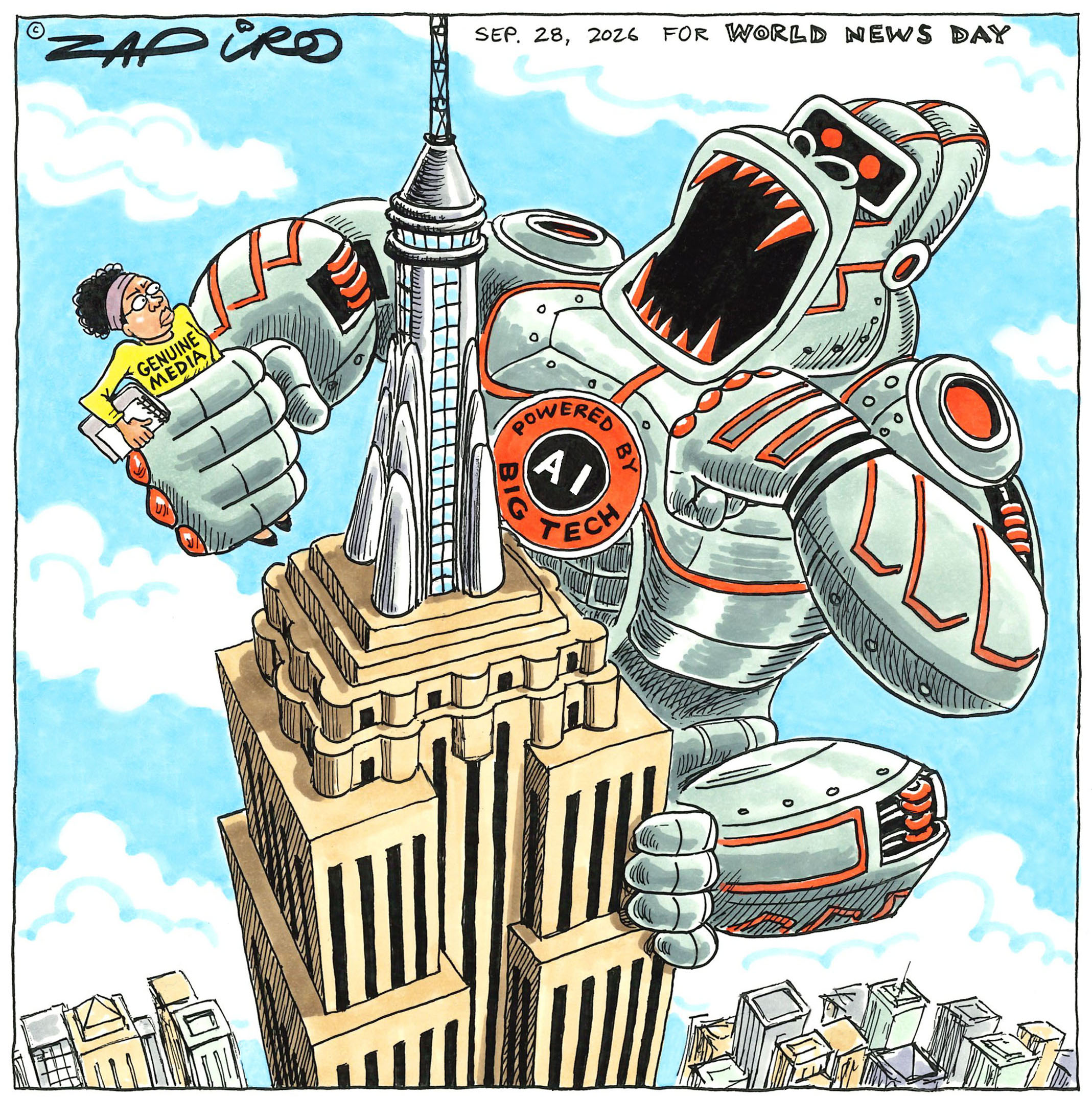
AI technology adds another layer of strain. Enterprise journalism takes time and money. While AI can improve research efficiency, it also threatens to undermine the economic foundations—and human judgment—on which credible journalism depends.
Public-interest journalism provides essential service: holding power accountable. Investigative reporting requires skill, perseverance, and above all, courage of conviction.
When governments operate in the shadows, when corporations exploit workers, or when officials lie, journalists function as democracy’s immune system by exposing corruption, secrecy, and abuse before irreparable harm occurs. Meaningful voting, legal redress, and civic participation all depend on access to trustworthy information that is delivered with neither fear nor favour.
The courage of conviction demands resistance, loud and persistent, to maintain rigorous and independent journalism. Our individual freedoms depend on journalists who refuse to be silenced.
Les démocraties occidentales, longtemps considérées comme des bastions de la liberté de la presse, ne sont plus à l’abri des pressions coercitives autrefois réservées aux régimes autoritaires. La liberté de la presse en Occident ne s’effondre pas subitement ; elle s’érode de façon systématique.
Les journalistes subissent des pressions de toutes parts : de la part de dirigeants populistes qui les qualifient d’ennemis du peuple, de la part de propriétaires de médias qui font passer leurs intérêts commerciaux avant la liberté de la presse, et d’un paysage médiatique en mutation qui a considérablement réduit les sources de revenus soutenant le journalisme indépendant.
Plus que jamais, les journalistes – et les propriétaires de médias – ont besoin du courage de leurs convictions pour résister à ces pressions et rester fidèles à un journalisme factuel.
« Le courage de ses convictions » est le thème du dîner de remise des prix 2026 de Liberté de la presse mondiale Canada, qui se tiendra au Centre national des Arts d’Ottawa le 29 avril.
Nous rendrons hommage aux journalistes qui, malgré la censure, l’intimidation, les menaces juridiques et les dangers qui les menacent, continuent de faire du journalisme d’intérêt public.
Les données révèlent une crise existentielle pour le journalisme traditionnel, fondé sur les faits.
Pour la première fois de son histoire, le Classement mondial de la liberté de la presse 2025 de Reporters sans frontières (RSF) a déclaré que la liberté de la presse mondiale se trouve dans une situation difficile.
L’indicateur économique de RSF montre que les médias sont de plus en plus pris au piège entre la préservation de leur indépendance éditoriale et leur survie financière. La fragilité économique est désormais la principale menace mondiale pour la liberté de la presse, affirme le rapport.
Comme le souligne Anne Bocandé, directrice éditoriale de RSF : « L’indépendance financière des médias est une condition nécessaire pour garantir une information libre et fiable, au service de l’intérêt public. »
Cette fragilité s’accentue à mesure que les tendances autoritaires gagnent du terrain au sein des systèmes démocratiques.
Le second mandat de Donald Trump a entraîné une nette détérioration de la liberté de la presse aux États-Unis.
Son administration a supprimé le financement fédéral de l’Agence américaine pour les médias mondiaux, affectant les publics et les médias du monde entier. Elle a instrumentalisé les institutions, marginalisé les journalistes et brouillé la frontière entre journalisme et propagande.
En janvier, des agents du FBI ont perquisitionné le domicile de la journaliste du Washington Post, Hannah Natanson, et saisi ses appareils dans le cadre d’une enquête pour fuite d’informations. Quelques semaines auparavant, l’émission « 60 Minutes » de CBS avait retiré de la diffusion un reportage sur les expulsions vers le Salvador, quelques heures seulement avant sa diffusion – malgré l’autorisation légale – car l’administration avait refusé de commenter. La correspondante Sharyn Alfonsi avait averti en interne que permettre la non-participation, qui entrave la diffusion d’informations, donnait de facto aux gouvernements un pouvoir de coupe sur le journalisme.
Ces pressions s’étendent au-delà des frontières. En octobre, lorsque le Premier ministre Mark Carney s’est rendu au sommet de paix du Moyen-Orient organisé par Trump, la Tribune de la presse parlementaire canadienne a été prévenue seulement trois heures avant son départ et exclue de l’événement. Qu’elle soit intentionnelle ou non, l’exclusion de la presse du contrôle compromet la responsabilité démocratique.
L’intelligence artificielle ajoute une nouvelle dimension à ces pressions. Le journalisme d’investigation exige du temps et de l’argent. Si l’IA peut améliorer l’efficacité de la recherche, elle menace également de fragiliser les fondements économiques – et le jugement humain – sur lesquels repose un journalisme crédible.
Le journalisme d’intérêt public rend un service essentiel : il permet de demander des comptes aux puissants. Le journalisme d’investigation exige du talent, de la persévérance et, surtout, du courage de ses convictions.
Lorsque les gouvernements agissent dans l’ombre, que les entreprises exploitent les travailleurs ou que les responsables mentent, les journalistes jouent le rôle de rempart de la démocratie en révélant la corruption, le secret et les abus avant que des dommages irréparables ne surviennent. Un vote éclairé, des recours juridiques et une participation citoyenne effective dépendent de l’accès à une information fiable, diffusée en toute impartialité.
Le courage de nos convictions exige une résistance forte et constante pour préserver un journalisme rigoureux et indépendant. Nos libertés individuelles reposent sur des journalistes qui refusent d’être réduits au silence.
*Indiciates required field