November 27, 2025
Share:
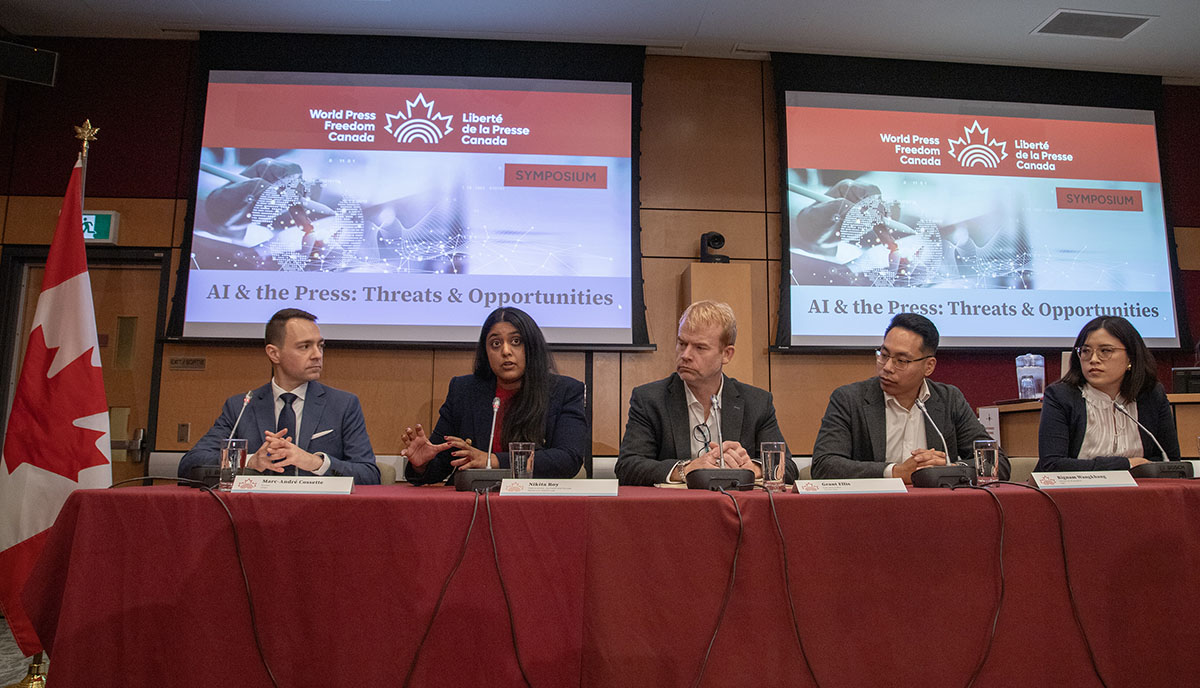
Canadian media companies have to re-imagine how they gather, produce and disseminate news in order to remain relevant and viable in the age of Artificial Intelligence, AI expert Nikita Roy told the WPFC symposium.
Roy was part of a panel on AI in the Newsroom: Promise and Peril. She is a data scientist, Knight Ridder fellow on AI for the International Center for Journalists, and host of the acclaimed podcast, Newsroom Robots.
She reiterated Hugo Larochelle’s message that AI is a tool that can enhance media work. However, she warned that too many journalists are lacking in AI literacy and therefore approach it with fear and resistance.
A more fundamental challenge, Roy said, is the failure of media companies to address the core challenges that AI adoption will pose for them, not just in the news gathering and writing but in their entire operation.
“The biggest mistake that we could make is not thinking about this as a technology transformation and just focussing on AI efficiency and adoption in the newsroom,” she told the symposium. This is an issue of “business transformation; this is not an existential threat for journalism but it is an existential threat for every news company that fails to evolve today.”
Media companies’ websites, for example, will have to be re-engineered to compete with the likes of ChatGPT Pulse, which will soon be rolled out and will provide a personalized news update every day.
AI is not only a tool for news gathering and dissemination, but also for business development, media entrepreneur Anita Li told the panel.
Li is a consultant, educator and founder and editor-in-chief of the Toronto-based The Green Line, a hyperlocal news site that targets young and other underserved Torontonians. She uses AI to target audiences and develop new sources of revenue.
“You can’t just close your eyes and say all these terrible things are happening and put your head in the sand,” Li said. “I chose to get ahead of it to help shape the way our industry is embracing AI.”
Newsroom managers from The Toronto Star and CBC told the panel that there is a range of attitudes among their staff, from a gung-ho embrace to fear of being displaced.
Grant Ellis, executive editor at The Toronto Star, said the newsroom is adopting AI tools, but media companies tend to be focused on short-term challenges. They struggle to think strategically.
“I am worried that the culture change that’s needed in order to really change minds about how we should be using AI means this will move far too slowly for us, given the forces we are up against right now,” Ellis said.
Rignam Wangkhang is AI adviser at CBC News, where he works to educate people on the promise and peril of artificial intelligence in the newsroom.
“We’re trying to find a balance between accommodating people and bringing them along while innovating at the speed we would hope, and the speed of the tech companies,” he said.
*Indiciates required field