Share:
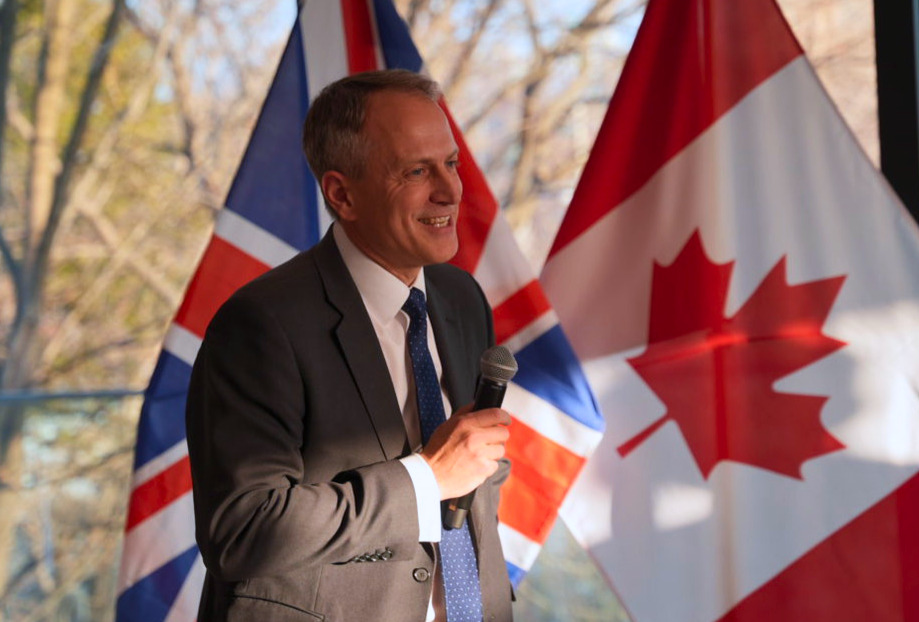
The spread of misinformation and disinformation in the age of AI, coupled with the decline of local news, poses a “really significant challenge” to press freedom, says Rob Tinline, the British high commissioner to Canada.
Tinline spoke to Dispatch ahead of the fifth annual media freedom dinner, which the high commission will host later this month in Ottawa. The black-tie dinner at Crichton Lodge will bring together about 100 journalists, high commission officials and representatives from the embassy of Finland, which co-chairs the Media Freedom Coalition with the U.K.
“It’s an opportunity for people to get to know each other,” he said. “It’s a chance to spend time with the media here in Ottawa, but it also keeps a focus on the issues. It’s certainly a moment in the year where we reflect back on how media freedom is developing.”
Tinline said it’s important to keep talking about the challenges, helping people develop critical skills to identify deepfakes and other false content. Established media have a responsibility to uphold high journalistic standards and maintain the public’s trust, he added.
“The amount of conversation that we’ve had not only in the U.K. but in Canada and elsewhere about disinformation, misinformation, is helping to embed in people’s minds that they do need to be critical of what they see,” he said
He pointed to the BBC, the U.K.’s public broadcaster, as an example of a large media institution with an authoritative voice to address misinformation and disinformation. “People respect and understand it has the highest standards of journalism,” he said.
Addressing social media companies’ algorithms and improving regulations to prevent youth from harm and deception is also important “to navigate a more complicated media landscape.”
The U.K. and Canada co-founded the Media Freedom Coalition in 2019, and served as its co-chairs until 2021. The global partnership of 51 countries exists to promote press freedom.
With financial pressures closing newsrooms and growing threats to journalists, press freedom remains essential, Tinline said. “It is absolutely a vital part of democracy,” he said.
“The media is a really, really important part” of holding people to account, he added. “It’s not always comfortable for people in government, but we recognize that it’s absolutely vital.”
Tinline identified the disappearance of local newsrooms as a genuine concern for press freedom. The U.K. and Canada have vibrant media, he said, but local outlets are essential to scrutinizing governments and helping citizens understand what is happening.
Tinline asked who “is asking the difficult questions” and digging into what local authorities are doing. He said it is “absolutely critical to have those democratic mechanisms — that there is somebody who helps the public understand what’s happening so it’s not simply government press releases.”
Reporters Without Borders ranked the U.K. 18th and Canada 20th on its Press Freedom Index; the United States ranked 64th, down from 57 last year. When asked about the rankings, Tinline said he could only speak for the U.K. “Whatever the precise ranking, the fundamental of press freedom is a treasured thing in the U.K.,” he said.
China ranks 178 out of 180, above North Korea and Eritrea. British citizen Jimmy Lai, a Hong Kong newspaper publisher and founder of the Apple Daily newspaper, was recently found guilty in China under over-broad national security laws. He was sentenced to 20 years in prison.
Tinline said he had no new updates on the case but that the U.K. government will remain vocal on the detention. “We will continue to be there. That case is not going to diminish.”
La propagation de la mésinformation et de la désinformation à l’ère de l’intelligence artificielle, conjuguée au déclin de l’information locale, constitue un « enjeu vraiment important » pour la liberté de la presse, affirme Rob Tinline, haut-commissaire britannique au Canada.
Tinline s’est entretenu avec The Dispatch avant le cinquième dîner annuel sur la liberté des médias, que le haut-commissariat organisera plus tard ce mois-ci à Ottawa. Ce dîner en tenue de soirée, qui se tiendra au Crichton Lodge, réunira une centaine de journalistes, de représentants du haut-commissariat et de représentants de l’ambassade de Finlande, qui copréside la Coalition pour la liberté des médias avec le Royaume-Uni.
« C’est l’occasion pour les gens de faire connaissance », a-t-il fait valoir. « C’est l’occasion de passer du temps avec les médias ici à Ottawa, mais cela permet également de rester concentrés sur les enjeux. C’est certainement un moment de l’année où nous réfléchissons à l’évolution de la liberté des médias. »
Selon Tinline, il est important de continuer à parler de ces enjeux et d’aider les gens à développer les compétences critiques nécessaires pour repérer les hypertrucages et autres contenus falsifiés. Les médias établis ont la responsabilité de respecter des normes journalistiques élevées et de maintenir la confiance du public, a-t-il ajouté.
« Toutes les discussions que nous avons eues, non seulement au Royaume-Uni, mais aussi au Canada et ailleurs, sur la désinformation et la mésinformation contribuent à faire comprendre aux gens qu’ils doivent exercer leur esprit critique face à ce qu’ils voient », a-t-il insisté.
Il a cité la BBC, le radiodiffuseur public britannique, comme exemple d’une grande institution médiatique disposant d’une voix faisant autorité pour lutter contre la mésinformation et la désinformation. « Les gens la respectent et comprennent qu’elle applique les normes journalistiques les plus élevées », a-t-il affirmé.
Il est également important de s’attaquer aux algorithmes des entreprises de médias sociaux et d’améliorer la réglementation afin de protéger les jeunes contre les préjudices et la tromperie, notamment pour « mieux naviguer dans un paysage médiatique plus complexe ».
Le Royaume-Uni et le Canada ont cofondé la Coalition pour la liberté des médias en 2019 et en ont assuré la coprésidence jusqu’en 2021. Ce partenariat mondial, qui regroupe 51 pays, vise à promouvoir la liberté de la presse.
Avec les pressions financières qui entraînent la fermeture de salles de rédaction et les menaces croissantes envers les journalistes, la liberté de la presse demeure essentielle, a déclaré Tinline. « C’est absolument une composante essentielle de la démocratie », a-t-il affirmé.
« Les médias jouent un rôle vraiment, vraiment important » pour demander des comptes aux personnes au pouvoir, a-t-il ajouté. « Ce n’est pas toujours confortable pour les intervenants du gouvernement, mais nous reconnaissons que c’est absolument essentiel. »
Tinline a identifié la disparition des salles de rédaction locales comme une véritable préoccupation pour la liberté de la presse. Le Royaume-Uni et le Canada disposent de médias dynamiques, a-t-il déclaré, mais les médias locaux sont essentiels pour surveiller les gouvernements et aider les citoyens à comprendre ce qui se passe.
Tinline s’est demandé qui « pose les questions difficiles » et examine de près les actions des autorités locales. Il a déclaré qu’il est « absolument essentiel d’avoir ces mécanismes démocratiques — qu’il y ait quelqu’un qui aide le public à comprendre ce qui se passe, afin que l’information ne se résume pas simplement aux communiqués de presse du gouvernement ».
Reporters sans frontières a classé le Royaume-Uni au 18e rang et le Canada au 20e rang de son Classement mondial de la liberté de la presse ; les États-Unis se sont classés au 64e rang, contre le 57e l’an dernier. Interrogé sur ces classements, Tinline a déclaré qu’il ne pouvait parler que du Royaume-Uni. « Quel que soit le classement précis, le principe fondamental de la liberté de la presse est une valeur précieuse au Royaume-Uni », a-t-il déclaré.
La Chine se classe au 178e rang sur 180, devant seulement la Corée du Nord et l’Érythrée. Le citoyen britannique Jimmy Lai, éditeur de journaux à Hong Kong et fondateur du Apple Daily, a récemment été reconnu coupable en Chine en vertu de lois sur la sécurité nationale formulées en termes très larges. Il a été condamné à 20 ans de prison.
Tinline a déclaré qu’il n’avait aucune nouvelle information à communiquer sur cette affaire, mais que le gouvernement britannique continuerait de dénoncer sa détention. « Nous continuerons d’être présents. Cette affaire continuera d’être suivie de près. »
*Indiciates required field