Share:
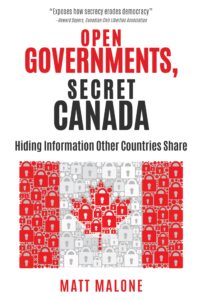 Columnist Ken Rubin spoke with author and lawyer Matt Malone about his new book examining Canada’s access-to-information regime and related legislation.
Open Governments, Secret Canada: Hiding Information Other Countries Share is published by James Lorimer & Company Ltd.
What got you to write this book on the state of access to information in Canada?
I first used the access-to-information system to gather some records for a project on trade secret law in Canada. That got me interested in the system itself. I took a detour to work on the Open by Default database. That work branched off into various research projects to try and wrap my head around the system, ending in my writing this book.
Is this the first comprehensive book on this subject, and why did it take over four decades for someone to tackle this subject?
There are some phenomenal books out there about access to information, such as Alasdair Roberts’ Blacked Out. But they are few and far between. I think it is because we don’t really fund transparency studies in Canada. The information commissioner doesn’t have a mandate to support research, nor do federal granting.
It just isn’t a popular or respected field in Canadian academia.
When did you get the idea that the best way to approach this was to get out of Canada to go to other countries and places?
Everyone knows the access-to-information system is broken. But identifying all the ways the system doesn’t work often leads to pessimism or cynicism. I wanted to enrich the conversation with a discussion about concrete ways we could address some problems. Comparative methodologies are promising because you can often see in action what works and what doesn’t.
Why did you take a broader approach to transparency and accountability beyond just the Access to Information Act?
Equating our thinking of transparency and accountability with the Access to Information Act is a mistake. Many statutes channel transparency and accountability.
As for the Access Act, the law is an outdated and limited mechanism. Far too often, it has been used to roll back transparency and accountability we once had.
To offer just one example, when the law was enacted in 1983, the exact salary of the governor of the Bank of Canada was well known; it was normally available and public information. Today, that exact same information is not public.
Did the countries you visited have a clue on Canada’s open government situation?
More than a few did. It always amused me when someone in Wellington or Helsinki would start discussing Canada’s transparency frameworks. One thing I found striking about several European countries is that their ombudsmen offices had international sections. Their explicit purpose was to monitor and develop partnerships with other countries.
What approaches to open government in other countries did you find most appealing?
Many of the organizations that work effectively in the countries I visited have real independence. In Canada, we are reluctant to empower watchdogs in the same way. We generally appoint tame, reluctant, risk-averse watchdogs with strong limitations on their funding. At best, we might get someone who is willing to have a final hurrah at the end of their career. But that is rare. Most watchdog appointments have become an award for civil servants who do not rock the boat. Or they are end-of-career treats for friends of the party in power. When is the last time we appointed a young person with lots of energy and new ideas to a watchdog role?
Why call Canada ‘secretive’ and near the bottom of the heap when it comes to open government?
Canada isn’t at the bottom by any means. But the book is optimistic about how we can do better, so I chose countries that rank above us. No ranking system is perfect, of course, and some are hard to take seriously.
What changes do you think are needed to make Canada transparent and accountable?
I believe there is a lot of promise in proactive disclosure, adopting new technologies in the delivery of the system, and providing more independent oversight and review. On a substantive level, we also desperately need to apply the act to the highest centres of power, like the staffers who work in ministers’ offices.
What did you leave out? Would you want to add? Done differently?
I wrote a little bit about the work throughout the 1970s and 1980s when the access law was being debated in committee in the House of Commons.
That was a very important period, led by [then-MPs] Barry Mather and then Ged Baldwin, but also featuring many figures like Francis Fox, Svend Robinson, Perrin Beatty, and professors such as Donald Rowat and Maxwell Cohen, as well as activists, including yourself.
It struck me how much of the law we have today is frozen in time from those discussions. Many provisions that generate so much frustration today—like the 20-year freeze on cabinet confidences—were chosen almost at whim, too. I wanted to write more about those debates, but worried it would render the work too historical.”
What is your next book, having now authored three books?
I am looking into writing about an episode in Canadian 20th-century history of betrayal, bribery, and corruption at the highest echelons of power where several relevant records that were previously restricted have recently opened. It is a great story but for now to tease the reader’s curiosity, yes, I am keeping the subject a secret.
Ken Rubin writes on transparency matters, and is reachable via kenrubin.ca.
This Q&A first appeared in The Hill Times. Reprinted with permission.
A Saskatchewan ruling has affirmed a principle journalists rely on: People don’t have to justify why they want public records.
The University of Saskatchewan had asked the province’s information commissioner to dismiss a purchasing-records request as frivolous because the applicant planned to use the information commercially.
Saskatchewan Information and Privacy Commissioner Grace Hession David refused, ruling that a commercial motive alone does not make an access request improper.
Why this matters: If a public body could reject a request because it judged the requester’s purpose insufficiently valuable, journalists, researchers and other members of the public could face a narrower path to public records.
The university was directed to continue processing the request.
Le chroniqueur Ken Rubin s’est entretenu avec l’auteur et avocat Matt Malone au sujet de son nouveau livre, qui examine le régime canadien d’accès à l’information et les lois qui l’encadrent.
Open Governments, Secret Canada: Hiding Information Other Countries Share est publié par James Lorimer & Company Ltd.
Qu’est-ce qui vous a poussé à écrire ce livre sur l’état de l’accès à l’information au Canada ?
J’ai utilisé le système d’accès à l’information pour la première fois afin d’obtenir des documents dans le cadre d’un projet sur le droit des secrets commerciaux au Canada. Cela a éveillé mon intérêt pour le système lui-même. J’ai ensuite fait un détour pour travailler sur la base de données Open by Default. Ce travail a donné lieu à divers projets de recherche visant à mieux comprendre le fonctionnement du système, ce qui m’a finalement amené à écrire ce livre.
Est-ce le premier ouvrage exhaustif sur le sujet ? Et pourquoi a-t-il fallu plus de quatre décennies pour que quelqu’un s’y attaque ?
Il existe des ouvrages remarquables sur l’accès à l’information, notamment Blacked Out, d’Alasdair Roberts. Mais ils sont rares. Je crois que c’est parce que nous ne finançons pas véritablement la recherche sur la transparence au Canada. Le Commissariat à l’information n’a pas le mandat de soutenir la recherche, et les organismes fédéraux de financement de la recherche ne la soutiennent pas non plus.
Ce n’est tout simplement pas un domaine populaire ni particulièrement valorisé dans le milieu universitaire canadien.
À quel moment avez-vous eu l’idée que la meilleure façon d’aborder le sujet serait de sortir du Canada pour examiner ce qui se fait ailleurs ?
Tout le monde sait que le système d’accès à l’information est défaillant. Mais dresser la liste de toutes ses lacunes mène souvent au pessimisme ou au cynisme. Je voulais enrichir le débat en examinant des solutions concrètes à certains problèmes. Les méthodes comparatives sont prometteuses, car elles permettent souvent d’observer directement ce qui fonctionne et ce qui ne fonctionne pas.
Pourquoi avoir adopté une approche plus large de la transparence et de la reddition de comptes, plutôt que de vous limiter à la Loi sur l’accès à l’information ?
C’est une erreur de réduire notre conception de la transparence et de la reddition de comptes à la seule Loi sur l’accès à l’information. De nombreuses lois contribuent à assurer la transparence et la reddition de comptes.
Quant à la Loi sur l’accès à l’information, il s’agit d’un mécanisme désuet et limité. Trop souvent, elle a servi à faire reculer la transparence et la reddition de comptes dont nous bénéficiions auparavant.
Prenons un seul exemple : lorsque la loi a été adoptée en 1983, le salaire exact du gouverneur de la Banque du Canada était bien connu. Il s’agissait normalement d’une information publique et facilement accessible. Aujourd’hui, cette même information n’est plus publique.
Les pays que vous avez visités connaissaient-ils la situation du Canada en matière de gouvernement ouvert ?
Plusieurs la connaissaient. Cela m’amusait toujours de voir quelqu’un, à Wellington ou à Helsinki, se mettre à discuter des mécanismes de transparence du Canada. Une chose qui m’a frappé dans plusieurs pays européens, c’est que les bureaux des ombudsmans comportaient des sections internationales. Leur mission explicite consistait à suivre l’évolution de la situation dans d’autres pays et à établir des partenariats avec eux.
Quelles approches en matière de gouvernement ouvert adoptées dans d’autres pays vous ont le plus séduit ?
Bon nombre des organismes qui fonctionnent efficacement dans les pays que j’ai visités jouissent d’une véritable indépendance. Au Canada, nous hésitons à accorder autant de pouvoirs à nos organismes de surveillance. Nous nommons généralement des personnes dociles, hésitantes et peu enclines à prendre des risques, tout en imposant d’importantes restrictions à leur financement.
Dans le meilleur des cas, nous pouvons tomber sur quelqu’un qui souhaite accomplir un dernier coup d’éclat en fin de carrière. Mais c’est rare. La plupart des nominations à la tête des organismes de surveillance sont devenues des récompenses pour des fonctionnaires qui ne font pas de vagues. Ou encore, des cadeaux de fin de carrière offerts à des amis du parti au pouvoir.
À quand remonte la dernière fois où nous avons nommé à un poste de surveillance une jeune personne débordante d’énergie et d’idées nouvelles ?
Pourquoi qualifier le Canada de pays « secret » et le situer presque au bas du classement en matière de gouvernement ouvert ?
Le Canada n’est certainement pas au dernier rang. Mais mon livre se veut optimiste quant aux possibilités d’amélioration. J’ai donc choisi d’étudier des pays qui se classent devant nous. Bien sûr, aucun système de classement n’est parfait, et certains sont difficiles à prendre au sérieux.
Quels changements faudrait-il apporter, selon vous, pour rendre le Canada plus transparent et améliorer la reddition de comptes ?
Je crois que la divulgation proactive, l’adoption de nouvelles technologies pour moderniser le fonctionnement du système ainsi qu’une surveillance et des mécanismes de révision plus indépendants offrent des perspectives très prometteuses.
Sur le fond, il est également urgent d’étendre l’application de la loi aux plus hauts échelons du pouvoir, notamment au personnel des cabinets ministériels.
Qu’avez-vous laissé de côté ? Y a-t-il des éléments que vous auriez aimé ajouter ou traiter différemment ?
J’ai consacré quelques passages aux travaux menés dans les années 1970 et 1980, lorsque le projet de loi sur l’accès à l’information faisait l’objet de débats en comité à la Chambre des communes.
Ce fut une période très importante, marquée par le leadership des députés de l’époque Barry Mather, puis Ged Baldwin, mais aussi par la participation de nombreuses personnalités comme Francis Fox, Svend Robinson et Perrin Beatty, de professeurs comme Donald Rowat et Maxwell Cohen, ainsi que de militants, dont vous-même.
J’ai été frappé de constater à quel point la loi actuelle est restée figée dans les discussions de cette époque. De nombreuses dispositions qui suscitent tant de frustrations aujourd’hui, comme la période de confidentialité de 20 ans imposée aux documents du Cabinet, ont elles aussi été choisies de façon presque arbitraire.
J’aurais aimé approfondir ces débats, mais je craignais de donner à mon ouvrage un caractère trop historique.
Vous avez maintenant trois livres à votre actif. Quel sera le prochain ?
J’envisage d’écrire sur un épisode de l’histoire canadienne du XXe siècle marqué par la trahison, les pots-de-vin et la corruption aux plus hauts échelons du pouvoir. Plusieurs documents pertinents, auparavant soumis à des restrictions d’accès, sont récemment devenus accessibles.
C’est une histoire fascinante, mais pour le moment, histoire de piquer la curiosité des lecteurs, oui, je préfère garder le sujet secret.
Ken Rubin écrit sur les questions de transparence. On peut le joindre par l’intermédiaire de son site Web, kenrubin.ca.
Cet entretien a été publié initialement dans The Hill Times. Reproduit avec autorisation.
Le chroniqueur Ken Rubin s’est entretenu avec l’auteur et avocat Matt Malone au sujet de son nouveau livre, qui examine le régime canadien d’accès à l’information et les lois qui l’encadrent.
Open Governments, Secret Canada: Hiding Information Other Countries Share est publié par James Lorimer & Company Ltd.
*Indiciates required field